
The “Smart Bidding Is Broken” Audit: How Too Many Conversions + Too Little Signal Derails Performance
A growth-focused advertiser came in with plenty of activity in Google Ads… but almost no reliable learning. The audit score was “BROKEN” for Smart Bidding health, and the root cause wasn’t mysterious: the account was asking automation to optimize toward the wrong things, with almost no true conversion signal to learn from.
Introduction: when “automation” becomes an expensive guess
I recently ran a Google Ads audit for a growth-focused advertiser (think app + web signup flow, performance-driven, lots of campaigns running). On the surface, it looked “busy” in the best way: multiple campaigns, multiple conversion actions, and Smart Bidding everywhere.
But in the last 90 days, the account’s Growth Score landed at 42 (BROKEN) with material waste signals flagged across modules. Issue volume wasn’t subtle either: 27 critical, 37 high, 12 medium.
This is the kind of account many agency owners inherit:
- The client wants scale yesterday
- The dashboard shows conversions… but the business says “these aren’t real”
- Every campaign is on tCPA or Max Conversions because it “should work”
Key takeaway: Smart Bidding doesn’t fail randomly. It fails predictably when you feed it mixed goals and thin signal.
The symptoms we saw (and why they’re easy to miss)
The account had “conversion volume,” but it was scattered across too many primary actions. That creates a comforting illusion: numbers go up, and Google’s bidding system appears to have something to optimize.
In reality, the campaigns that mattered had either:
- Too few goal-aligned conversions to train bidding reliably, or
- Zero goal-aligned conversions while still using tCPA
Meanwhile, measurement modules told the same story from different angles:
- Bidding & Smart Bidding Health: score 0 with a large cluster of major issues
- Attribution & Measurement: score 0 (this usually pairs with conversion configuration problems)
The result is what I call “automation drift”: Google optimizes perfectly… just not toward what you actually care about.
Diagnosis process: how I triage this in 30 minutes
When I’m auditing an account like this, I’m not starting with keywords or ads. I’m starting with what the system is being asked to optimize.
Here’s the sequence I follow (and it’s repeatable across most lead gen + app hybrid accounts):
1. List primary conversions (not all conversions—only the ones marked Primary).
2. Map each Primary conversion to an actual business outcome (revenue, qualified lead, booked call, etc.).
3. Check goal-aligned conversion volume per campaign over the audit window (90 days is fine).
4. Compare bid strategy to data reality:
- tCPA with 0 conversions is a red flag.
- Max Conversions with single digits of true outcomes is usually unstable.
5. Look for segmentation drift (brand/non-brand mixed, app/web mixed, too many micro-goals competing).
This audit lit up immediately at steps 1–4.
Root cause #1: too many Primary conversions (Smart Bidding averaged across everything)
The account had 8 primary conversions active, while the max recommended in the audit framework was 3.
This is one of the most common agency inheritance problems because it happens slowly:
- Someone adds a new micro-event (signup start, view content, button click)
- It gets marked Primary “temporarily”
- Smart Bidding starts chasing the easiest event (often the lowest-intent one)
- Performance looks “better” in-platform while lead quality or downstream revenue declines
Why it matters (in plain terms): Smart Bidding is not reading your mind. It sees Primary conversions as the definition of success. If you give it eight definitions, it will optimize toward the mix that yields the most conversions at the lowest cost—often the opposite of qualified volume.
Fix direction from the audit: keep only the strongest outcomes as Primary; move micro-events to Secondary.
In practice, for most accounts, that means:
- Primary (1–3 actions):
- Purchase / paid subscription
- Qualified lead (with strict rules)
- Booked call / completed application
- Secondary:
- Sign up start
- Button clicks
- Page views
- App sign-in (unless it is truly the north star)
Key takeaway: If your Primary conversions aren’t your KPI, your KPIs won’t improve—no matter how “smart” the bidding is.
Root cause #2: Smart Bidding deployed without enough (or any) goal-aligned conversions
The audit flagged multiple campaigns running tCPA or Max Conversions with extremely low true conversion volume.
Examples from the pattern:
- A campaign using Maximize Conversions with only a handful of goal-aligned conversions in 90 days
- Several campaigns using Target CPA with 0 goal-aligned conversions in the same 90-day window
This is where many teams get stuck. Google’s UI encourages Smart Bidding, and on mature accounts it’s fantastic. But Smart Bidding is a learning system.
If a campaign has 0 real conversions, the algorithm can’t learn what a converter looks like. It will either:
- Bid based on proxy signals (which can be wildly off), or
- Converge toward cheap traffic that completes low-intent actions (especially if those are Primary)
The audit’s recommendation was the right general principle:
- Use a simpler bid strategy until the account has 30+ real conversions per month on the actual goal.
[IMAGE:

Chart mock showing “Conversions/month” threshold vs. recommended bidding approach]
This is not an anti-automation stance. It’s pro-sequencing.
What we changed: a pragmatic fix plan agencies can apply fast
This is the part agency owners care about: what to do on Monday that doesn’t require a month-long rebuild.
1) Re-define “success” inside Google Ads
Start by cleaning up conversion configuration.
- Reduce Primary conversions to 1–3 true outcomes
- Move micro-events to Secondary
- Ensure all campaigns are optimizing to the same core definition of success (unless intentionally segmented)
If you only do one thing from this post, do this.
2) Match bid strategy to conversion reality (per campaign)
For campaigns with low or zero goal-aligned conversions, stop forcing tCPA.
A practical ladder I use:
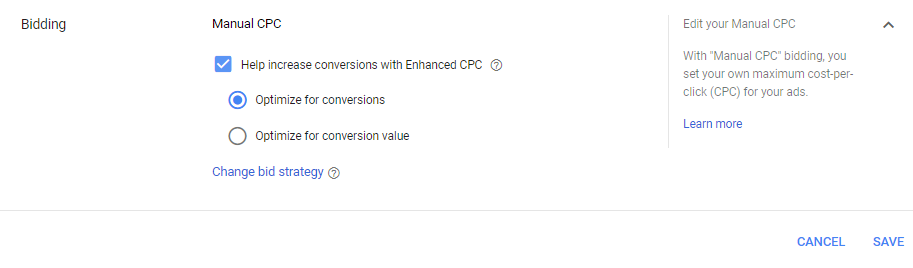
- Manual CPC / Enhanced CPC (when you need controlled learning and the account is messy)
- Maximize Clicks with guardrails (only if you can tightly control query quality)
- Maximize Conversions (when you have enough real conversions, not micro-events)
- Target CPA / Target ROAS (when volume is stable and tracking is trusted)
Key principle: you earn Smart Bidding by having clean goals and enough signal. You don’t install it and hope.
3) Consolidate or pause “dead learning” campaigns
In the audited account, multiple campaigns were effectively in permanent learning failure (0 goal-aligned conversions over 90 days).
Common agency move: pause or consolidate until you can generate enough conversion density.
- Merge overlapping ad groups/campaigns where intent is similar
- Shift budget to the campaigns that can realistically produce learning signal
- Keep experiments small and time-boxed
This reduces waste and accelerates the return to stable optimization.
Lessons learned (what I’d tell another agency owner)
This audit wasn’t about one weird setting. It was a system design issue.
Here are the repeatable lessons:
- Primary conversions are strategy. Treat them like the definition of revenue, not a checklist.
- Smart Bidding isn’t a cure-all. It amplifies your measurement quality—good or bad.
- Volume thresholds matter. If you don’t have enough true conversions, pick a bidding method that fits reality.
- A “busy” account can still be broken. Lots of campaigns and lots of “conversions” can hide the fact that none of it aligns to business outcomes.
If you’re inheriting accounts, always audit conversions and bid strategy before touching keywords. It’s the fastest way to stop silent waste.
How we’d operationalize this inside an agency (simple SOP)
If you want to turn this into a repeatable internal process, here’s a lightweight SOP:
- Audit Primary conversions (count + goal alignment)
- Choose 1–3 Primary outcomes; demote the rest
- For each campaign, compare bid strategy vs. goal-aligned conversion count
- Downgrade bidding where signal is insufficient (temporarily)
- Consolidate campaigns to increase conversion density
- Re-evaluate after 2–4 weeks of clean data
This is how you stop the “Smart Bidding is broken” narrative—and replace it with controlled iteration.
Closing: want the audit template?
If you’re an agency owner, you’ve probably seen some version of this: too many conversion actions, automation turned on too early, and performance that looks fine in-platform but doesn’t map to business reality.
If you want, you can try the VEOtool beta or request an audit and I’ll share the exact checks I run (conversion integrity, bidding health, measurement consistency) so you can apply them across your client roster—without turning it into a massive rebuild.
Want to sanity-check an account like this? Try the VEOtool beta or request a lightweight Google Ads audit—we’ll flag conversion goal conflicts, Smart Bidding readiness issues, and the fastest fixes to reduce waste without overhauling everything.
Request an audit