
When Smart Bidding Breaks: A SaaS Google Ads Audit Case Study
This anonymized Google Ads audit shows a common failure mode for SaaS growth accounts: too many “primary” conversions and aggressive Smart Bidding with too little real volume, leading to unstable performance and wasted spend.
Introduction
This case study is based on a recent Google Ads audit for a growth focused advertiser (think SaaS, performance minded, actively testing). The account was evaluated on a Purchase style primary goal over the last 30 days.
The headline score was 56 (UNSTABLE) with high data confidence. In plain English: the account had enough data to diagnose problems, but the system was being asked to optimize toward conflicting signals.
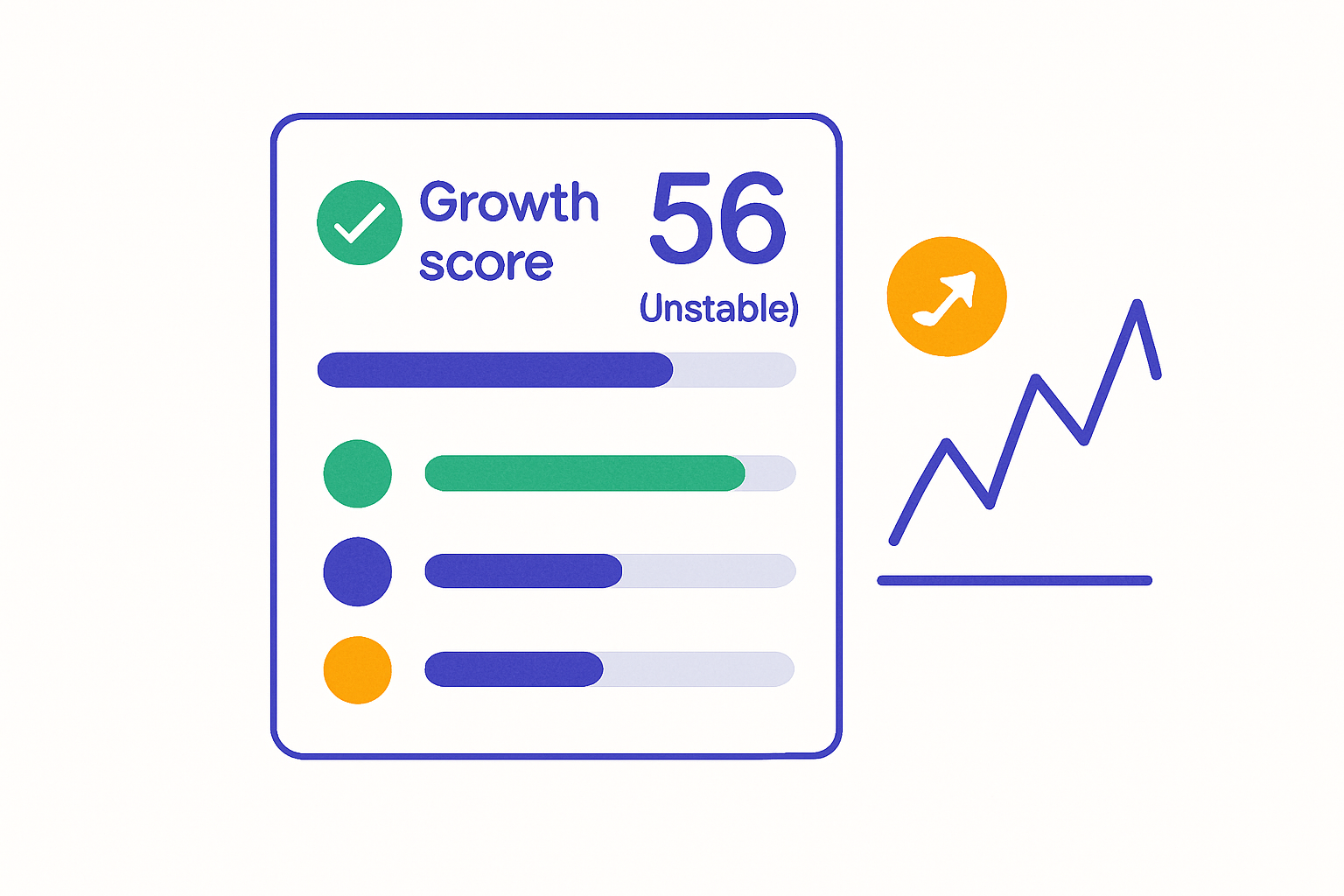
Here were the symptoms that triggered the audit in the first place:
- A few campaigns showed “good looking” CPAs, while others were wildly inefficient
- One high spend campaign delivered zero recorded outcomes in the period
- Bidding strategies were largely automated, but performance did not look automated in a good way (volatile and inconsistent)
Key takeaway: When an account feels unpredictable, the first place to look is not creative. It is measurement and bidding inputs.
Context: why SaaS founders get stuck here
SaaS teams often evolve Google Ads in layers. A founder or marketer starts with Search, adds Performance Max, imports conversions from GA4, then someone adds Firebase or another source, and suddenly “more data” becomes “more noise.”
At the same time, Smart Bidding promises efficiency, so it is tempting to switch most campaigns to Target CPA or Target ROAS early.
That combination is where many accounts quietly break:
- Multiple primary conversions compete with each other
- Automated bidding optimizes toward the easiest conversion event, not the most valuable one
- Low conversion volume makes bid algorithms unstable
What the audit revealed (and how we diagnosed it)
We approached this audit in the order that Google Ads actually learns:
- Conversion definitions (what counts as success)
- Attribution and duplication (is success counted correctly)
- Bidding strategy fit (is automation appropriate for volume)
- Campaign and asset group behavior (where spend is leaking)
Across the account, there were 11 critical issues and 10 high severity issues in a 30 day window.
Finding 1: Too many primary conversions
The account had 6 primary conversions active.
That is a common pattern in SaaS: you want to see every step (signup, trial, key event, purchase), so you set them all to Primary. The downside is that Smart Bidding does not treat those events as a funnel. It treats them as equal optimization targets.
Practically, that causes two problems:
- Automated bidding starts chasing the easiest event to generate, not the event closest to revenue
- CPA and ROAS become hard to interpret because the “conversion” is not consistently the same thing
If you tell Google that six different actions are equally valuable, it will believe you.
Finding 2: Duplicate purchase counting across sources
The audit also flagged that the same purchase could be counted twice due to multiple measurement sources being imported and marked as primary (for example: app analytics source + GA4 import both reporting purchases).
This inflates conversion counts, which then:
- Makes Smart Bidding think it has more learning data than it really does
- Lowers reported CPA artificially
- Can push Target ROAS or Target CPA into unrealistic thresholds
In SaaS, this often happens when teams:
- Track the same event in GA4 and another platform
- Import both into Google Ads
- Forget to set one source to Secondary
The core issue: Smart Bidding was over applied for the conversion volume
The most severe module score in the audit was Bidding and Smart Bidding Health: 0.
The underlying pattern was consistent:
- Many campaigns were using advanced strategies (Target ROAS, Target CPA, Maximize Conversion Value, Maximize Conversions)
- But there were too few goal aligned conversions to support stable learning
Specifically, the audit flagged:
- 8 campaigns on Target ROAS with insufficient goal aligned conversions
- 1 campaign on Target CPA with insufficient goal aligned conversions
- 3 campaigns on Maximize Conversion Value with insufficient goal aligned conversions
- 2 campaigns on Maximize Conversions with insufficient goal aligned conversions
This is where SaaS founders should pay attention: Smart Bidding is not a magic switch. It is a statistical system that needs a minimum amount of clean, consistent conversion data.
A practical rule of thumb used in audits like this is:
- If you are not driving roughly 30+ true, goal aligned conversions per month per campaign (or portfolio), Target CPA and Target ROAS can become unstable
When volume is low, Smart Bidding often does one of the following:
- Over bids into broad inventory to “find” conversions
- Optimizes toward micro conversions if they are incorrectly marked as Primary
- Swings performance week to week because it is learning on noise
The most expensive symptom: high spend with zero outcomes
One campaign sat in the top tier of account spend and produced zero conversions (no primary or secondary outcomes) during the audit period.
This is not always a catastrophe. Sometimes a campaign is intentionally reach based.
But in a performance SaaS motion, it is usually a measurement or alignment issue, such as:
- The campaign objective does not match the conversion goal
- Tracking is broken on a specific landing page or flow
- The campaign is spending on queries or placements that cannot realistically convert
- Conversion actions are filtered out or not eligible for the campaign type
In this audit, the practical recommendation was straightforward:
- Pause or restructure the campaign until measurement and intent alignment are confirmed
- If it truly is upper funnel, label it as such and stop judging it like a direct response campaign

Creative and asset group leakage (where performance quietly bleeds)
While measurement and bidding were the primary root causes, the audit also found a creative structure problem:
- An asset group spent beyond the implied target CPA without producing goal aligned conversions
In Google Ads, asset groups can keep spending even when they are misaligned, especially when the account wide conversion signals are messy.
Common reasons this happens in SaaS:
- Messaging is feature led when the market needs problem led
- Landing pages load slowly or bury the primary CTA
- Audience intent is too broad (for example: “business software” rather than “SOC 2 compliance software” level intent)
The point is not “creative is bad.” The point is: creative performance becomes impossible to evaluate when the bidding system is trained on muddy conversions.
Fix plan: how we would stabilize an account like this
Below is the general, anonymized remediation plan we recommend in situations like this. It is designed to stabilize learning first, then scale.
1) Simplify primary conversions (make the goal unambiguous)
- Choose 1 to 3 primary conversions max
- Use the closest proxy to revenue as Primary (paid subscription, qualified booked demo, completed checkout)
- Move all micro conversions (trial start, page view, add to cart, button click) to Secondary
A smaller set of clean primary conversions is usually better than a long list of “nice to track” events.
2) Remove double counting across sources
- Identify overlapping purchase events across GA4 imports and other sources
- Pick one “source of truth” for the primary purchase conversion
- Set duplicates to Secondary (or remove imports entirely if not needed)
- Validate that one user action equals one conversion in reporting
3) Right size bidding strategies to conversion volume
If conversion volume is thin, you typically get better stability by stepping down the automation ladder:
- Start with Maximize Clicks or Manual CPC with enhanced signals (depending on account maturity)
- Use broader learning windows and fewer changes
- Move back to Target CPA or Target ROAS only when you have stable volume on the true goal
For accounts that want automation but lack volume per campaign, a middle ground is:
- Consolidate into fewer campaigns or use portfolio strategies so conversion data aggregates
4) Stop funding zero outcome campaigns until they are explained
- Verify tracking on the exact landing pages and funnels used by the campaign
- Confirm the campaign type is eligible to optimize toward the chosen conversion action
- If the campaign is upper funnel, separate it and measure it with appropriate KPIs
5) Re evaluate asset groups after measurement is fixed
Once conversion tracking is clean and bidding is stable:
- Review asset group intent alignment
- Refresh messaging to match the decision stage
- Improve landing page clarity and speed
Lessons learned for SaaS founders running Google Ads
This audit was not a story about one bad keyword list or one weak ad.
It was a story about inputs.
When the account’s success definition is unclear, Smart Bidding will still do its job. It will just optimize toward the wrong thing.
If you are a SaaS founder looking at inconsistent Google Ads performance, sanity check these first:
- Do you have more than 3 primary conversions?
- Could one purchase be counted twice across sources?
- Are you using Target CPA or Target ROAS without enough monthly conversions on the true goal?
- Do you have any high spend campaigns with no recorded outcomes?
Most “Google Ads isn’t working” situations are really “measurement and bidding aren’t aligned.”
Want a second set of eyes?
If you are testing Google Ads for your SaaS and performance feels unstable, we are opening up the VEOtool beta to founders and lean teams who want fast, practical audit feedback.
If you would rather not DIY the cleanup, you can also request an anonymized style audit review and we will point out the highest leverage fixes first.
Interested in a lightweight audit like this? Try the VEOtool beta or request a quick review of your Google Ads conversion setup and bidding strategy alignment.
Request an audit